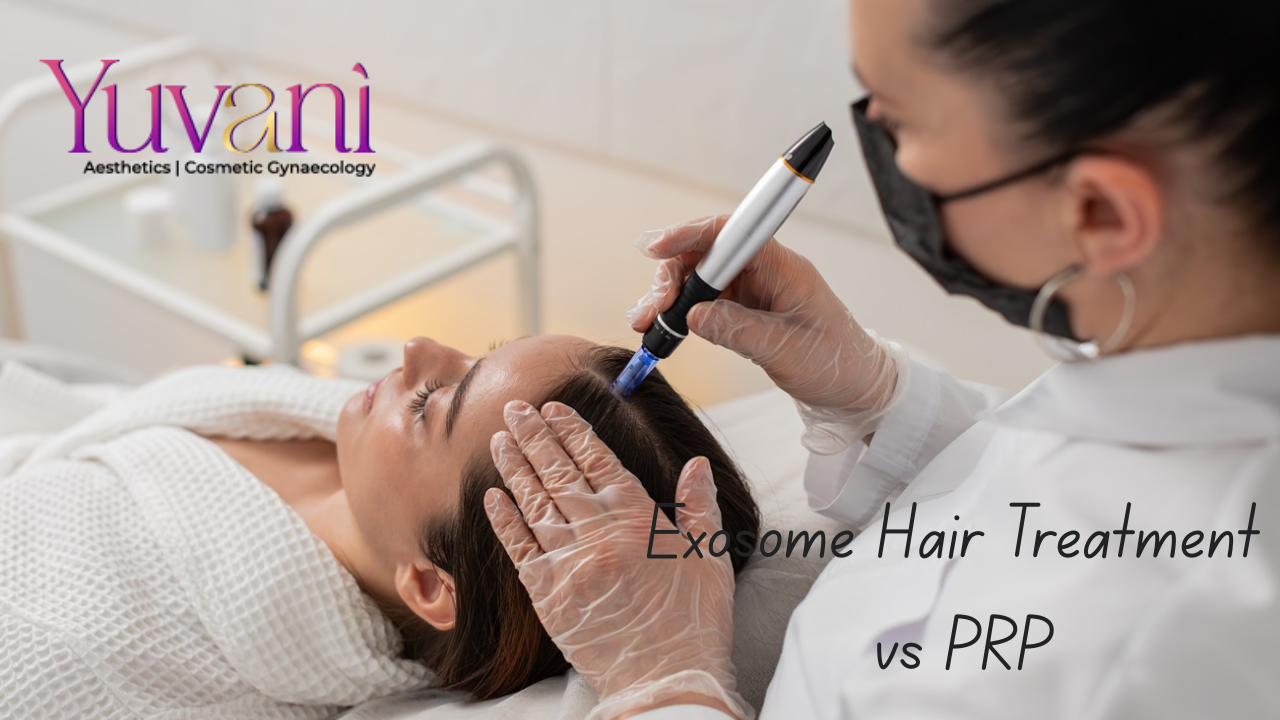
Hair thinning can be frustrating, especially when you begin noticing increased hair fall, reduced density, or a widening parting. With several non-surgical hair treatments now available, it can be difficult to understand which option may be suitable for your condition. Two treatments that are increasingly discussed for hair concerns are Exosome Hair Treatment and PRP (Platelet-Rich Plasma) therapy.
Both approaches are designed to support the scalp environment and hair follicles, but they work in different ways. PRP uses components derived from your own blood, while exosome-based treatments use biologically derived extracellular vesicles that contain signalling molecules. Their composition, preparation, evidence, suitability, and regulatory considerations are also different.
If you are considering Exosome Hair Treatment, understanding how it compares with PRP can help you have a more informed discussion with a qualified hair specialist.
What Is Exosome Hair Treatment?
Exosomes are microscopic extracellular vesicles involved in cell-to-cell communication. They can contain proteins, lipids, messenger RNA, and other signalling molecules.
In aesthetic and regenerative medicine, exosome-based products are being investigated and used in some settings for skin and hair applications. For hair concerns, the proposed goal is to support communication around hair follicles and potentially create a more favourable environment for hair growth.
The exact composition and quality of exosome products can vary considerably depending on their source, manufacturing process, purification, storage, and regulatory status.
Because of this, the term "exosome treatment" does not describe one standardized procedure or product.
What Is PRP Hair Treatment?
PRP stands for Platelet-Rich Plasma. It is prepared from a person's own blood.
During a typical PRP procedure:
- A small amount of blood is collected.
- The blood is processed to separate the platelet-rich portion.
- The concentrated plasma is prepared for treatment.
- PRP is administered to targeted areas of the scalp.
Platelets contain growth factors and other proteins involved in tissue repair and signalling. The goal of PRP treatment for hair loss is to support the hair follicles and potentially improve hair density or reduce ongoing thinning in appropriately selected patients.
PRP has been studied more extensively for certain types of hair loss than many newer regenerative approaches.
Exosome Hair Treatment vs PRP: Key Differences
| Feature | Exosome Hair Treatment | PRP Hair Treatment |
|---|---|---|
| Source | Depends on the specific exosome product | Patient's own blood |
| Main concept | Cell-to-cell signalling through extracellular vesicles | Platelet-derived growth factors and signalling proteins |
| Blood collection | Usually not required for the exosome product itself | Required |
| Preparation | Depends on the commercial or clinical product | Prepared from the patient's blood |
| Evidence | Emerging and still developing | More established for selected hair-loss conditions |
| Standardisation | Can vary significantly between products | More established clinical protocols |
| Suitability | Depends on product, diagnosis, and patient factors | Depends on diagnosis and overall health |
| Results | Variable and still being studied | Variable; multiple sessions are often used |
The most important difference is that PRP is an autologous treatment, meaning it comes from your own blood, whereas exosome products are externally sourced and require careful consideration of their origin and quality.
How Does PRP Work for Hair Loss?
PRP is thought to work through the growth factors and signalling proteins contained within platelets.
When administered to the scalp, these factors may influence processes involved in tissue repair and follicular activity. Research has investigated PRP particularly for androgenetic alopecia, commonly known as pattern hair loss.
Some patients may experience:
- Reduced appearance of thinning
- Improved hair density
- Improved hair shaft thickness
- Support for existing miniaturised follicles
However, PRP does not guarantee new hair growth in every patient. It is generally more useful when viable but weakened hair follicles are still present.
How Might Exosomes Support Hair Follicles?
Exosome-based approaches are being studied because extracellular vesicles can carry signalling molecules between cells.
In theory, these signals may influence processes involved in:
- Cellular communication
- Tissue repair
- Inflammation
- Angiogenesis
- Hair follicle activity
Early studies and clinical reports have generated interest in exosome-based hair treatments. However, the quality of evidence is not yet comparable with established hair-loss treatments, and more high-quality clinical research is needed.
This is an important point when comparing exosome therapy with PRP: newer does not automatically mean better.
Which Treatment Has More Scientific Evidence?
At present, PRP has a larger body of clinical research behind it for certain forms of hair loss than exosome-based treatments.
PRP has been evaluated in clinical studies and systematic reviews, particularly for androgenetic alopecia. Results vary between studies because protocols differ in platelet concentration, preparation methods, injection techniques, treatment intervals, and patient characteristics.
Exosome therapy is a newer area of interest. Early research is promising enough to justify further investigation, but evidence remains limited and treatment products are not necessarily equivalent.
Therefore, a responsible consultation should consider the quality of evidence rather than choosing a treatment simply because it is marketed as more advanced.
Exosome Hair Treatment vs PRP: Which Is Better?
There is no universal answer.
The better option depends on factors such as:
- The type of hair loss
- Duration of hair thinning
- Degree of follicle miniaturisation
- Age and overall health
- Scalp condition
- Previous treatments
- Treatment goals
- Availability and quality of the specific product
- Medical assessment by a qualified professional
For some patients, PRP may be a reasonable option because of its established clinical experience. For others, an exosome-based approach may be discussed as an emerging treatment option.
The important thing is to diagnose the cause of hair loss before selecting a procedure.
Who May Benefit From PRP?
PRP may be considered for selected patients with conditions such as androgenetic alopecia or early-to-moderate pattern hair thinning.
It may be less suitable when there is extensive, long-standing hair loss with significant follicle destruction.
PRP is also not a replacement for diagnosing underlying causes of sudden or unexplained hair loss.
Who May Be Considered for Exosome Hair Treatment?
Exosome-based hair treatments may be discussed for individuals experiencing certain types of hair thinning where follicles are still present.
However, suitability depends heavily on the particular product and treatment protocol being offered.
Before proceeding, patients should ask:
- What is the source of the exosomes?
- How is the product manufactured?
- Is the product appropriately regulated or authorized for its intended use?
- What evidence supports its use for hair loss?
- What are the known risks?
- How is the product stored and handled?
These questions are particularly important because "exosome" is not a single standardized treatment.
Can PRP and Exosome Treatments Be Combined?
Some clinics may offer combination approaches, but combining treatments does not automatically mean better results.
A combination should only be considered when there is a clear clinical rationale. Your specialist should assess your diagnosis, previous treatments, scalp condition, and expected benefits before recommending more than one procedure.
Adding multiple treatments simply because they are available can increase cost and treatment burden without necessarily improving outcomes.
How Many Sessions Are Needed?
Treatment schedules vary.
PRP is commonly performed as a series of sessions followed by maintenance treatments, depending on the patient's response and the treating doctor's protocol.
Exosome treatment schedules can vary even more because different products and protocols are used.
Rather than choosing a treatment based on a fixed number of sessions advertised online, discuss the expected treatment plan with your specialist.
When Can You Expect Results?
Hair growth is naturally slow, so results should not be judged immediately after treatment.
Depending on the underlying condition and treatment used, visible changes may take several months. Some patients may notice changes in shedding or hair texture before they notice a meaningful difference in overall density.
Results also vary from person to person.
Photographs taken under consistent lighting and hair-parting conditions can be useful for monitoring progress over time.
Are There Side Effects?
Both treatments can cause temporary discomfort because they involve procedures on the scalp.
Possible effects may include:
- Mild pain or tenderness
- Redness
- Swelling
- Temporary sensitivity
- Bruising
- Short-term scalp discomfort
PRP uses the patient's own blood components, while exosome products introduce an externally sourced biological product. Therefore, the safety profile of an exosome treatment depends significantly on the source, processing, sterility, quality control, and clinical use of that particular product.
Your doctor should explain the expected risks before treatment.
What If Hair Loss Has Another Cause?
Not every case of hair thinning should be treated with PRP or exosomes.
Hair loss can be associated with:
- Iron deficiency
- Thyroid disorders
- Nutritional deficiencies
- Hormonal changes
- Polycystic ovary syndrome
- Recent illness or significant stress
- Certain medications
- Scalp conditions
- Autoimmune disorders
- Genetic pattern hair loss
If hair loss is sudden, severe, patchy, or accompanied by scalp inflammation, a proper medical evaluation is especially important.
Treating the underlying cause may be more important than proceeding directly with a cosmetic hair procedure.
Exosome Hair Treatment vs PRP: What Should You Choose?
If you are trying to decide between the two, avoid choosing based solely on marketing claims.
A specialist should first determine:
What is causing your hair loss?
Then the discussion can move to:
Which treatment has the best evidence and risk-benefit profile for your specific situation?
PRP may be a suitable option for some patients because it has greater clinical experience and research support. Exosome therapy may be considered an emerging option, but patients should carefully evaluate the specific product and evidence before proceeding.
Final Thoughts
Both Exosome Hair Treatment in Navi Mumbai and PRP are attracting attention as non-surgical approaches for hair thinning, but they are not the same treatment.
PRP uses your own platelet-rich plasma and has a relatively established evidence base for selected types of hair loss. Exosome-based treatment is a newer area of regenerative medicine, with promising early research but important questions around standardisation, product quality, evidence, and regulation.
The right choice depends on the cause and stage of hair loss, the condition of your scalp and follicles, and the treatment options available from a qualified specialist.
If you are considering Exosome Hair Treatment, a detailed consultation can help determine whether it is appropriate for your hair concerns or whether a more established treatment such as PRP may be more suitable.
Frequently Asked Questions
Is Exosome Hair Treatment better than PRP?
Not necessarily. Exosome therapy is newer and has emerging evidence, while PRP has been studied more extensively for certain types of hair loss. The appropriate option depends on the individual.
Is PRP made from my own blood?
Yes. PRP is prepared from a sample of your own blood, which is processed to concentrate platelets and plasma before being used on the scalp.
Does Exosome Hair Treatment require blood collection?
The exosome product itself generally does not require collecting your blood. However, the exact procedure depends on the product and protocol being used.
Can both treatments regrow lost hair?
Neither treatment can guarantee hair regrowth. They may be more useful when viable hair follicles remain and the underlying condition is suitable for treatment.
How long do PRP or exosome results last?
The duration of results varies between individuals and depends on the cause of hair loss, treatment protocol, response, and ongoing management. Maintenance treatment may be recommended in some cases.
Should I get a hair-loss diagnosis before treatment?
Yes. Identifying the cause of hair loss is an important first step. A specialist may recommend examination, scalp assessment, or laboratory testing when appropriate before suggesting a treatment.

 Call Us
 WhatsApp