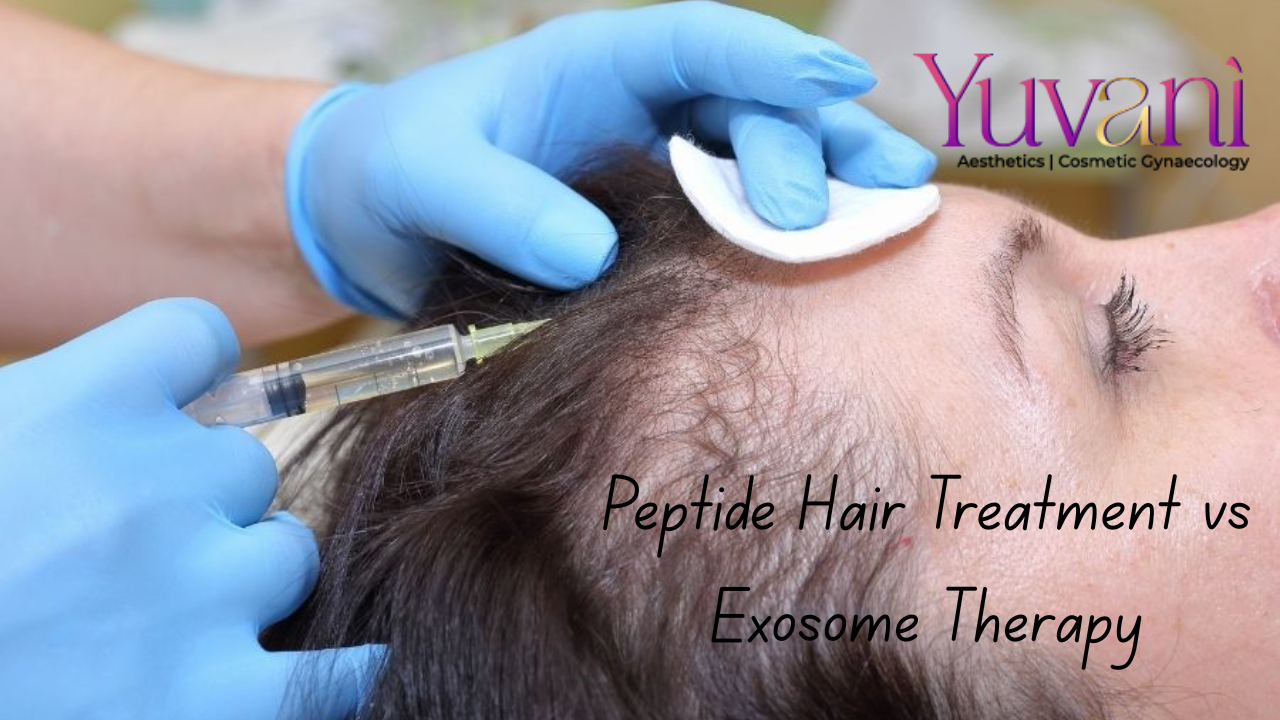
Hair thinning can develop gradually, making it difficult to identify when your hair started losing its density. You may notice more hair shedding than usual, a widening part, reduced volume around the crown, or hair that appears finer than before. Although these changes can be frustrating, understanding the cause of hair loss is the first step towards choosing an appropriate treatment.
Among the newer options discussed in aesthetic hair care are peptide hair treatments and exosome therapy. Both are promoted for their potential role in supporting hair health, but they differ in composition, proposed mechanisms, scientific evidence, and safety considerations.
If you are considering Peptide Hair Treatment in Navi Mumbai or Exosome Hair Treatment in Navi Mumbai, understanding how these approaches compare can help you make a more informed decision.
What Is Peptide Hair Treatment?
Peptides are short chains of amino acids, the building blocks of proteins. Certain peptides are being studied for their potential effects on biological processes associated with skin and hair follicle function.
In hair care, peptide-based formulations may be applied topically or administered through specific clinical procedures, depending on the product. Their ingredients and intended uses can vary considerably.
Some peptide formulations are marketed to support the scalp environment, improve the appearance of thinning hair, or complement other hair-loss treatments. However, the effectiveness depends on the particular ingredients, formulation, method of application, and evidence supporting its use.
Peptide hair treatment is not one standardised procedure. A topical peptide serum, a professional scalp formulation, and an injectable product may have very different safety profiles and levels of evidence.
How May Peptides Support Hair Health?
Different peptides can have different biological effects. Researchers are investigating whether certain peptides can influence signalling pathways associated with hair follicle activity.
Depending on the formulation, proposed treatment goals may include:
- Supporting the scalp environment
- Complementing a hair-care or hair-loss management routine
- Improving the appearance of weak or thinning hair
- Supporting selected aspects of hair follicle function
These are potential goals rather than guaranteed outcomes. Evidence for one peptide cannot automatically be applied to all peptide-based hair products.
What Is Exosome Hair Treatment?
Exosomes are tiny extracellular vesicles released by cells. They help cells communicate by carrying biological materials such as proteins, lipids, and certain types of RNA.
Researchers are studying exosomes for their potential role in cellular communication, inflammation, and tissue-related processes. This has generated interest in their possible application in hair restoration.
Products marketed as exosome hair treatments are intended to influence signalling around hair follicles. However, their composition, source, manufacturing methods, and quality controls can vary.
Exosome therapy for hair loss remains an emerging area of research. Early findings are of scientific interest, but high-quality clinical evidence is still limited, and many marketed products do not have sufficiently established evidence for reliable hair regrowth.
How Might Exosome Therapy Work?
The proposed approach involves using extracellular vesicles and the biological signals they carry.
Researchers are investigating whether these signals may influence processes related to:
- Communication between cells
- The scalp's local environment
- Inflammatory responses
- Biological pathways involved in hair follicle activity
However, laboratory findings do not automatically translate into effective treatment in humans. The benefits and risks depend on the specific product and how it is used.
Peptide Hair Treatment vs Exosome Therapy: Key Differences
Although both approaches are discussed in connection with hair thinning, they are not interchangeable.
| Feature | Peptide Hair Treatment | Exosome Hair Treatment |
|---|---|---|
| Composition | Formulations containing specific peptides or peptide complexes | Products containing extracellular vesicles or marketed as exosome-based |
| Proposed mechanism | Depends on the peptide and its biological activity | Involves extracellular vesicles that carry biological signals |
| Treatment method | May be topical or involve a product-specific professional procedure | Depends on the product and intended route of application |
| Research status | Varies by peptide, formulation, and intended use | Emerging field with limited clinical evidence for many hair-loss applications |
| Standardisation | Depends on the product and formulation | Can vary substantially by source and manufacturing process |
| Expected results | Depend on the specific ingredients and underlying hair condition | Uncertain; results cannot be guaranteed |
| Safety considerations | Depend on ingredients and application method | Depend on source, manufacturing quality, sterility, and application method |
The most important distinction is that neither treatment should be judged by its name alone. The specific formulation, quality, supporting research, and suitability for your type of hair loss matter much more.
Which Treatment Is Better for Hair Thinning?
There is no universal answer.
Peptide-based products may be worth discussing when there is credible evidence for the specific formulation and intended use. Exosome-based products may be presented as a newer option, but their effectiveness for hair loss remains uncertain.
Before choosing either treatment, consider the following factors.
1. The Cause of Hair Loss
Hair thinning can result from genetic pattern hair loss, hormonal changes, nutritional deficiencies, stress, illness, medication effects, or scalp conditions.
A treatment that may be considered for one type of hair loss may not be appropriate for another. Identifying the cause should come before selecting a procedure.
2. The Evidence Behind the Product
Ask whether clinical studies have evaluated the exact product being offered for your particular concern.
Evidence supporting a peptide in a laboratory setting is not the same as evidence that a commercial treatment produces meaningful hair growth in people. Similarly, results from early exosome research should not be treated as proof that every exosome product is effective.
3. The Treatment Method
A topical product, a product used alongside microneedling, and an injectable preparation involve different considerations.
The method should be appropriate for the product's intended use. A product intended for topical application should not automatically be introduced into the skin through microneedling or injection.
4. Your Expectations
Some people want to reduce shedding, while others hope to improve hair density or address advanced baldness. These goals require different approaches.
Neither peptides nor exosomes should be expected to restore hair in areas where follicles have been permanently lost.
Can Peptide Hair Treatment Improve Hair Density?
Peptide hair treatments are marketed for a variety of hair concerns, but their effectiveness depends on the formulation.
Some peptides are being investigated for their role in biological signalling, including processes that may be relevant to hair follicle function. However, evidence supporting visible improvements in hair density varies, and not all commercial products have been tested in robust clinical trials.
If you are considering Peptide Hair Treatment in Navi Mumbai, ask your practitioner which peptides the product contains and what human clinical evidence supports its use.
It is also important to establish whether your thinning is caused by pattern hair loss, a temporary shedding condition, or another medical issue. Treatment should address the underlying cause whenever possible.
Can Exosome Therapy Help With Hair Regrowth?
Exosome therapy has attracted attention because of research into extracellular vesicles and their role in cellular communication.
Early studies and small clinical investigations have explored possible applications in hair loss. However, the available evidence is still limited, and more high-quality research is needed to determine which products, if any, provide meaningful and reliable benefits.
Claims of guaranteed regrowth, permanent results, or dramatic follicle regeneration should be treated cautiously.
Before considering Exosome Hair Treatment in Navi Mumbai, ask about the product's origin, composition, manufacturing standards, intended use, regulatory status, and clinical evidence.
Who May Be Suitable for These Treatments?
Suitability depends on the exact product and the cause of hair thinning.
A hair specialist may consider the following factors before recommending a treatment:
- Whether hair loss is recent or longstanding
- Whether the thinning is diffuse or follows a pattern
- Whether hair follicles remain active
- Whether there is scalp inflammation or another skin condition
- Your medical history and current medications
- Previous hair-loss treatments
- Whether a better-supported treatment is available
People experiencing sudden, severe, patchy, or rapidly progressing hair loss should be medically evaluated before undergoing a cosmetic procedure.
Pregnant or breastfeeding individuals should seek medical advice before considering elective hair treatments, especially products with limited safety data.
What Happens During a Consultation?
A proper consultation should begin with an assessment of your hair and scalp rather than an immediate recommendation for a particular procedure.
Step 1: Discuss Your Symptoms
Your specialist may ask when the hair thinning began, whether shedding has increased, and whether you have noticed changes in hair density.
Step 2: Review Your Medical History
Hormonal changes, recent illness, nutritional issues, family history, medications, and previous treatments can all be relevant.
Step 3: Examine Your Scalp
A scalp examination or trichoscopy may help identify patterns of thinning, follicular changes, and signs of scalp disease.
Step 4: Consider Further Investigations
Blood tests may be recommended when the history or examination suggests a possible nutritional, hormonal, or other medical cause.
Step 5: Discuss Treatment Options
The practitioner should explain the potential benefits, limitations, risks, costs, and evidence behind each recommended option.
This process helps ensure that treatment is based on your condition rather than marketing claims.
Are Peptide and Exosome Hair Treatments Safe?
Safety depends on the formulation, quality, and method of administration.
Potential Considerations for Peptide Treatments
Depending on the product, possible concerns include scalp irritation, sensitivity, allergic reactions, or other effects associated with the ingredients. Procedures involving injections or microneedling introduce additional risks.
Potential Considerations for Exosome Treatments
Exosome products may differ in biological source, manufacturing process, purity, and quality controls. Poorly characterised products or inappropriate administration can create safety concerns.
Potential complications may include irritation, inflammation, contamination-related infection, or reactions to the product.
For either approach, ask the provider:
- What is the exact product name and ingredient list?
- Where does the product come from?
- Is it intended and appropriately authorised for the proposed use?
- What clinical evidence supports its effectiveness?
- What are the known risks?
- What alternatives are available?
Do not assume that a product is safe or effective simply because it is described as regenerative, advanced, or clinically inspired.
What Other Treatments Are Available for Hair Loss?
Peptide and exosome treatments are only two of the options that may be discussed for hair thinning. Depending on the diagnosis, more established treatments may be appropriate.
Minoxidil
Topical minoxidil is a commonly used treatment for certain types of pattern hair loss. It may help some patients maintain or improve hair growth, although results vary and ongoing use is generally needed to maintain benefits.
Prescription Medication
Selected patients may benefit from prescription treatments. Suitability depends on the type of hair loss, medical history, sex, pregnancy considerations, and potential side effects.
PRP Hair Treatment
Platelet-rich plasma, or PRP, is prepared from a patient's own blood. It has been studied for certain types of pattern hair loss, although results vary and treatment protocols differ.
Nutritional Assessment
Iron deficiency and certain nutritional problems can contribute to hair loss. Correcting a confirmed deficiency may be more appropriate than proceeding directly with a cosmetic treatment.
Hair Transplantation
A hair transplant may be considered for suitable patients with established hair loss and adequate donor hair. It differs from non-surgical treatments because it involves transferring hair follicles to selected areas.
A qualified specialist can help determine which approach is most suitable for your diagnosis and goals.
How Long Does It Take to See Results?
Hair growth is gradual, and treatment results cannot usually be judged immediately.
For peptide-based products, the expected timeframe depends on the ingredients and evidence supporting the formulation. For exosome therapy, the lack of standardised products and robust clinical data makes reliable predictions particularly difficult.
If a treatment is effective, visible changes may take several months. Some people may see little or no improvement.
Photographs taken under consistent lighting and hair-parting conditions can help track changes in density over time. Your specialist should also explain how treatment success will be assessed and when to reconsider the plan if results are limited.
How to Choose a Hair Treatment Clinic in Navi Mumbai
If you are exploring Peptide Hair Treatment in Navi Mumbai or Exosome Hair Treatment in Navi Mumbai, look beyond promotional claims.
Choose a provider who:
- Evaluates the cause of your hair loss before recommending treatment
- Clearly identifies the product being used
- Explains the quality and limitations of the available evidence
- Discusses risks, alternatives, and expected costs
- Does not promise guaranteed hair regrowth
- Provides follow-up to assess whether the treatment is helping
A clinic should be willing to explain why a treatment is appropriate for your particular condition, including when another approach may be more effective.
Final Thoughts
Peptide hair treatment and exosome therapy are different approaches being explored for hair thinning. Peptide formulations contain specific chains of amino acids, while exosomes are extracellular vesicles involved in cellular communication.
Both are promoted in the hair restoration market, but their effectiveness depends on the product, its intended use, and the quality of supporting evidence. Exosome therapy, in particular, remains an emerging field, and many claims about hair regrowth require stronger clinical support.
If you are considering Peptide Hair Treatment in Navi Mumbai or Exosome Hair Treatment in Navi Mumbai, start with a professional assessment to identify the cause of your hair loss. Your specialist can help you compare these approaches with established options and choose a plan based on your medical needs, realistic expectations, and safety.
Frequently Asked Questions
Is peptide hair treatment better than exosome therapy?
Neither is universally better. The effectiveness of peptide treatments depends on the specific formulation, while exosome therapy remains an emerging area with limited clinical evidence for many hair-loss applications.
Can exosome therapy regrow hair in bald areas?
It should not be assumed to regrow hair in areas where follicles have been permanently lost. Evidence for reliable hair regrowth with exosome-based products remains limited.
How many sessions of peptide hair treatment are needed?
The number of sessions depends on the product, application method, and treatment protocol. Ask your provider for the recommended schedule and the evidence supporting it.
Is exosome hair treatment safe?
Safety depends on the product's source, manufacturing quality, intended use, and method of administration. Ask about these factors and the potential risks before proceeding.
Can women undergo peptide or exosome hair treatment?
Women may be considered for selected treatments, but the cause of hair loss should first be assessed. Hormonal changes, nutritional deficiencies, and other medical conditions may require specific management.
Should I try PRP before peptide or exosome treatment?
Not necessarily. The appropriate option depends on your diagnosis, medical history, and treatment goals. PRP has more clinical research for certain forms of pattern hair loss than many newer regenerative approaches, but it is not suitable for everyone.
How do I choose between peptide and exosome hair treatments in Navi Mumbai?
Ask about the exact product, ingredients or biological source, clinical evidence, risks, intended use, and alternatives. A qualified hair specialist should explain whether either treatment is appropriate for your specific type of hair loss.

 Call Us
 WhatsApp